
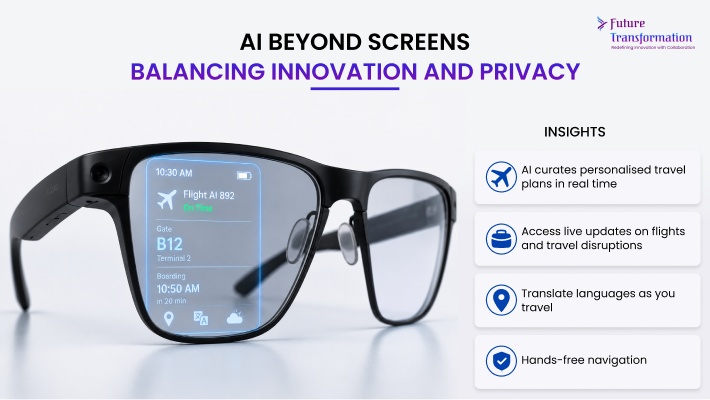
AI beyond screens.
A traveler walks through a busy airport without looking at a phone.
Flight updates arrive instantly.
Directions to the gate appear when needed.
A conversation in a foreign language is translated in real time.
It is the reality being enabled by a new generation of AI-powered wearables.
As artificial intelligence moves beyond screens and into devices we wear, it is reshaping how people travel, work, communicate and interact with the world around them.
Yet, alongside this transformation comes a growing responsibility to protect privacy, secure personal data and build public trust.
Worldwide wearable device shipments reached 611.5 million units in 2025, reflecting growing consumer adoption.
Key Challenges
• Increased collection of personal and behavioral data raises privacy concerns.
• Continuous monitoring and data tracking can create risks of unauthorized access and misuse.
• AI-generated insights may occasionally provide inaccurate or misleading information.
• Limited transparency around data storage and processing can reduce user confidence.
• Existing regulations often struggle to keep pace with rapidly evolving AI technologies.
Recommendations
• Adopt privacy-by-design principles throughout product development.
• Strengthen cybersecurity measures to safeguard user information.
• Improve transparency regarding data collection, usage and retention practices.
• Establish clear governance frameworks for responsible AI deployment.
• Build trust through ethical innovation, accountability and user control.
The future of AI wearables will depend on creating solutions that deliver convenience while protecting privacy, strengthening security and earning public trust.
As AI becomes a seamless part of everyday life, the real challenge is making it more responsible.